QuaRot: Rotation-based Outlier Suppression Algorithm
Overview
- Source: Academic research or industry proposed method.
- Introduction: Quantization with Rotation (QuaRot) An innovative algorithm for the quantization of large language models that suppresses outliers in activation tensors through mathematical transformation. This algorithm "scatters" outliers into multiple channels by performing specific rotation transformations on weights and activation values. This significantly smoothes the data distribution before quantization and effectively reduces quantization error.
- Core idea: QuaRot applies a well-constructed orthogonal transformation (rotation matrix) to balance the maximum value of the transformed activation tensor on each channel as much as possible. This prevents a single channel from requiring an excessively large scaling factor due to extreme outliers, thereby improving overall quantization accuracy.
Preparations
Install msModelSlim. For details, see msModelSlim Installation Guide.
Principle and Implementation
Principle
- Core concept QuaRot transforms model weights and activation values by using an orthogonal rotation matrix (for example, a Hadamard matrix). The orthogonal matrix meets the key property of Q × Qᵀ = I to ensure mathematical equivalence of the model before and after transformation.
- Rotation transformation
Apply the transformation to the weight matrix W:
W' = Qᵀ × W. Apply the transformation to the activation value X:X' = X × Q. Maintain computational equivalence:X' × W' = (X × Q) × (QT × W) = X × W. -
Computational invariance The rotation transformation maintains the input-output mapping of each Transformer layer. Even if a layer includes an RMSNorm operation, computational invariance remains valid because
RMSNorm(X) = RMSNorm(X × Qᵀ) × Q. -
Optimization effect This algorithm redistributes parameters through rotation to effectively suppress outliers in activation values. This results in a smoother value distribution and significantly reduces the quantization error of subsequent operations, laying the foundation for low-bit quantization.
Implementation
Code Implementation
The algorithm is implemented in msmodelslim/processor/quarot/offline_quarot/quarot.py.
Processing Sequence
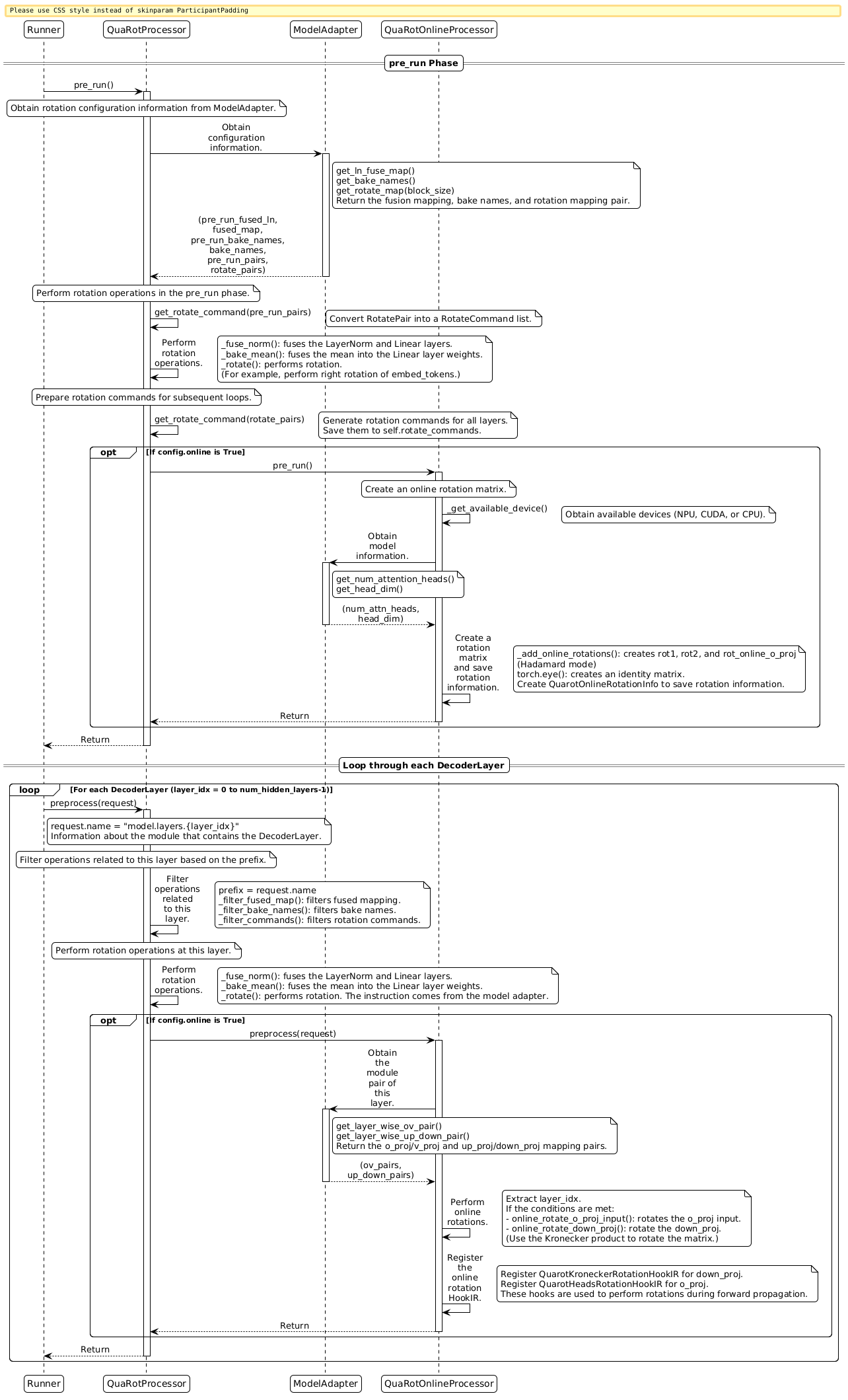
The following sequence diagram shows the complete processing flow of the QuaRot algorithm, including the interaction between Runner, QuaRotProcessor, ModelAdapter, and LAOSOnlineRotationProcessor.
pre_run Phase
The pre_run phase is executed before the Runner starts scheduling layers. It mainly completes the following operations:
Obtaining Configuration Information from the Model Adapter
- Calls
adapter.get_ln_fuse_map()to obtain the fusion mapping betweenLayerNormandLinearlayers. This returns(pre_run_fused_ln, fused_map), wherepre_run_fused_lnis used in thepre_runphase andfused_mapis saved for the subsequentpreprocessphase. - Calls
adapter.get_bake_names()to obtain the list ofLinearlayer names that require mean fusion. This returns(pre_run_bake_names, bake_names). - Calls
adapter.get_rotate_map(block_size)to obtain rotation mapping pairs. This returns(pre_run_pairs, rotate_pairs), wherepre_run_pairsis used in thepre_runphase androtate_pairsis saved for the subsequentpreprocessphase.
Performing Rotation Operations in the pre_run Phase
- Converts
pre_run_pairsinto aRotateCommandlist. - Executes
_fuse_norm(pre_run_fused_ln)to fuseLayerNormandLinearlayers. This fuses theLayerNormweight into theLinearlayer and sets theLayerNormweight to1. - Executes
_bake_mean(pre_run_bake_names)to fuse the mean into theLinearlayer weight (which is typically an empty list). - Executes
_rotate(pre_run_commands)to perform the rotation operation on the specified layer (such asmodel.embed_tokens).
Preparing Rotation Commands for Subsequent Loops
- Converts
rotate_pairsinto aRotateCommandlist and saves it toself.rotate_commandsfor use in thepreprocessphase.
(Optional) Exporting Global Rotation Information
- If
export_extra_infois set toTrue, the algorithm registersQuaRotExtraInfoHookIRwith the first rotation target module and exports the QuaRot global rotation matrix information in the saving phase. - After the export, the following files are added to the quantization save directory:
optional/quarot.safetensors: Contains a tensor with the keyglobal_rotation. This tensor is the global rotation matrixQused by QuaRot.optional.quarotfield inquant_model_description.json: Describes the additional export files mentioned above, facilitating file loading on the inference side based on the description.- The structure of
optional.quarotis as follows:
{
  "optional": { // Entry for optional export files
    "quarot": { // Additional export field of QuaRot
      "rotation_map": { // Rotation information mapping table
        "global_rotation": "optional/quarot.safetensors" // Global rotation matrix file (relative path)
      }
    }
  }
}
- If
export_extra_infoisFalse, the algorithm does not inject this hook and does not export the preceding information.
(Optional) Initializing Online Rotation
- If
online: Trueis configured, the algorithm callsonline_processor.pre_run()to perform the following operations:- Obtains the available devices (such as NPU, CUDA, or CPU).
- Obtains
num_attn_headsandhead_dimfrom the adapter. - Creates online rotation matrices (
rot1,rot2, androtonlineo_proj) and the identity matrix. - Creates a
QuarotOnlineRotationInfoobject to save the rotation information.
preprocess Phase
The preprocess phase executes when the Runner schedules each DecoderLayer, processing each decoder layer one by one.
Filtering Layer-Related Operations Based on the Prefix
- Extract the prefix (such as
"model.layers.0") fromrequest.name. - Call
_filter_fused_map(prefix)to filter out theLayerNormfusion mapping related to the layer fromself.fused_mapand remove it fromself.fused_map. - Call
_filter_bake_names(prefix)to filter out the bake names related to the layer fromself.bake_namesand remove them fromself.bake_names. - Call
_filter_commands(prefix)to filter out the rotation commands related to the layer fromself.rotate_commandsand remove them fromself.rotate_commands.
Performing Rotation Operations on the Layer
- Execute
_fuse_norm(fused_map)to fuse theLayerNormandLinearlayers of the current layer (such as the fusion ofinput_layernormandq_a_proj). - Execute
_bake_mean(bake_names)to fuse the mean of the current layer into theLinearlayer weights. - Execute
_rotate(rotate_commands)to perform the rotation operation on the layer. The specific content of the rotation operation is obtained from the model adapter.
(Optional) Performing Online Rotation
-
If
online: Trueis configured, the algorithm callsonline_processor.preprocess(request)to perform the following operations:- Obtain the
ov_pairs(mapping pairs ofo_projandv_proj) andup_down_pairs(mapping pairs ofup_projanddown_proj) of the layer from the adapter. - Extract
layer_idx. - Call
online_rotate_o_proj_input()to perform online rotation on the input ofo_projif conditions are met. -
Call
online_rotate_down_proj()to perform online rotation ondown_proj(using a Kronecker product rotation matrix) iflayer_idxexists in thedown_proj_online_layersconfiguration. -
Register
QuarotKroneckerRotationHookIRfordown_projandQuarotHeadsRotationHookIRforo_proj. These hooks perform rotation operations during forward propagation.
- Obtain the
post_run Phase
The post_run phase executes after the Runner finishes scheduling. It mainly completes the following operations:
- Execute the remaining fusion, bake, and rotation operations by processing the remaining content in
self.fused_map,self.bake_names, andself.rotate_commands. - Clear the status and empty all saved mapping and command lists.
- Call
online_processor.post_run()to convertHookIRtoWrapperIRif online rotation is enabled.
Application Requirements
- Model structure constraints: The current adapter supports the Qwen3 Dense model series, Qwen3 MOE model series, and DeepSeek-V3/R1 series.
- Tensor parallelism constraints: If online rotation is enabled, ensure that
tp_sizeis a power of 2 when deploying the model by using Tensor Parallelism (TP) in an inference engine. Additionally,tp_sizemust be less than or equal to themax_tp_sizeconfiguration parameter of QuaRot. Failure to meet these conditions leads to accuracy anomalies. - Online rotation constraints: Online rotation typically improves accuracy but requires the insertion of online rotation operators during deployment. This implementation depends on the support of the inference framework and reduces performance to some extent. Users must balance accuracy and performance based on the specific capabilities of their inference engine.
Function Description
Supported Ascend AI Processors
| Product Series | Supported |
|---|---|
| Atlas A3 training products/Atlas A3 inference products | ✓ |
| Atlas A2 training products/Atlas 800I A2 inference products | ✓ |
| Atlas inference products | ✗ |
Supported Models
Currently, the QuaRot algorithm supports the following model series.
| Model Series | Specific Model | Basic Rotation | Online Rotation | Remarks |
|---|---|---|---|---|
| Qwen3 Dense series | Qwen3-8B Qwen3-14B Qwen3-32B |
✓ | ✓ | Supports complete QuaRot functionality, including basic and online rotation. |
| Qwen3 MOE series | Qwen3-30B Qwen3-235B |
✓ | ✗ | Supports basic rotation functionality. |
| DeepSeek-V3/R1 series | DeepSeek-V3 DeepSeek-V3-0324 DeepSeek-R1 DeepSeek-R1-0528 DeepSeek-V3.1 DeepSeek-V3.2-Exp |
✓ | ✗ | Supports basic rotation functionality. |
| Qwen3-VL series | Qwen3-VL-32B | ✓ | ✗ | Supports basic rotation functionality. |
| Qwen3-VL-MoE series | Qwen3-VL-235B-A22B Qwen3-VL-30B-A3B |
✓ | ✗ | Supports basic rotation functionality. |
Notes:
- Basic rotation: All supported models implement the
QuaRotInterfaceand support basic rotation functionality. - Online rotation: Currently, only the
Qwen3 Denseseries models implement theLAOSOnlineRotationInterfaceand support online rotation functionality. To use online rotation, configureonline: True. - For models that do not implement the online rotation interface, setting
online: Truecauses an error.
YAML Configuration Example
The following example shows a YAML configuration when the algorithm is used as a processor:
spec:
  process:
    - type: "quarot"                     # Specifies the processor type. The value is fixed to quarot.
      online: False                      # Specifies whether to enable online rotation. The default value is False.
      block_size: -1                     # Specifies the block size when the block diagonal matrix is enabled. It must be -1 or a power of 2. The value -1 disables block diagonal matrix processing.
      max_tp_size: 4                     # Specifies the maximum tensor parallel size. The default value is 4. This parameter is valid only when online rotation is enabled. It must be a power of 2. The tp value set during model startup must be less than or equal to max_tp_size.
      down_proj_online_layers: [ ]       # Specifies the layers whose down_proj modules perform online rotation. The default value is an empty list.
      export_extra_info: True            # Specifies whether to export the global rotation matrix. The default value is True. If the value is true and ascend_v1_saver is used, an optional directory is generated in the directory of quantized weights and additional fields are added to quant_model_description.json.
YAML Configuration Fields
| Field | Purpose | Type | Description | Default Value |
|---|---|---|---|---|
| type | Specifies the processor type identifier. | string |
The value is fixed to quarot, which identifies the object as the QuaRot quantization processor. |
"quarot" |
| online | Specifies whether to enable online rotation. | bool |
True enables online rotation, and False disables it. |
False |
| block_size | Specifies the diagonal block size of the rotation matrix. | int |
The value can be -1 or a power of 2. The value -1 disables diagonal block matrix processing. |
-1 |
| max_tp_size | Specifies the maximum tensor parallel size. | int |
This parameter takes effect only when online rotation is enabled. The value must be 1 or a power of 2. |
4 |
| down_proj_online_layers | Specifies the layers where down_proj uses online rotation. | array[int] |
This field contains a list of layer indexes used to identify the layers whose down_proj modules perform online rotation. |
[] |
| export_extra_info | Specifies whether to export global rotation information. | bool |
If this field is set to True, the corresponding HookIR is injected. If ascend_v1_saver is used, an optional directory is generated in the directory of quantized weights to save additional safetensors (including the global rotation matrix of QuaRot), and description fields are added to quant_model_description.json. If it is set to False, no global rotation information is exported. |
True |
Model Adaptation
Interfaces and Data Structures
This interface group is used to enable the model to adapt to the QuaRot algorithm. The QuaRot algorithm contains two model adaptation interfaces: QuaRotInterface (basic rotation) and
LAOSOnlineRotationInterface (online rotation). If only the basic rotation functionality is required, only QuaRotInterface needs to be implemented. If the online rotation functionality is required, both interfaces must be implemented.
Data Structures
class QuaRotMode(Enum):
    HADAMARD = "hadamard"
    BLOCK_HADAMARD = "block_hadamard"
    BLOCK_HADAMARD_SHIFTED = "block_hadamard_shifted"


class RotSide(Enum):
    """Enumeration of rotation directions"""
    LEFT = "left" # Specifies the left rotation.
    RIGHT = "right" # Specifies the right rotation.


@dataclass
class RotateCommand:
    """Rotation command data class"""
    target: str # Specifies the name of the target module.
    rot: Any # Specifies the rotation matrix.
    side: RotSide # Specifies the rotation direction.


@dataclass
class RotatePair:
    """Rotation pair data class, including the mapping of left rotation and right rotation"""
    left_rot: Dict[str, Any] # Specifies the left rotation mapping: {module name: rotation matrix}.
    right_rot: Dict[str, Any] # Specifies the right rotation mapping: {module name: rotation matrix}.
QuaRotInterface
class QuaRotInterface:
    """Basic rotation interface of QuaRot for adapting models to the basic rotation functionality"""

    # Static method: Create a rotation matrix.
    @staticmethod
    def get_rotate_command(mode: QuaRotMode,
                           size: int,
                           block_size: int = -1,
                           rot_step: int = 1,
                           eye_step: tuple = (-1,)) -> torch.Tensor:
        """
        Create a rotation matrix.

        Args:
            mode: Specifies the rotation mode (such as HADAMARD and BLOCK_HADAMARD)
            size: Specifies the matrix size.
            block_size: Specifies the block size. The value -1 disables block diagonal matrix processing.
            rot_step: Specifies the rotation step.
            eye_step: Specifies the step of the unit matrix.

        Returns:
            The rotation matrix
        """
        ...

    @abstractmethod
    def get_ln_fuse_map(self) -> Tuple[Dict[str, List[str]], Dict[str, List[str]]]:
        """
        Obtain the fusion mapping between the LayerNorm and Linear layers.

        Returns:
            A tuple containing two dictionaries:
            - pre_run_fused_ln (Dict[str, List[str]]): Specifies the fusion mapping in the pre_run phase.
            - fused_map (Dict[str, List[str]]): Specifies the fusion mapping in the preprocess phase.
            The key of the dictionary is the name of the LayerNorm layer, and the value is the list of names of Linear layers to be fused.
        """
        ...

    @abstractmethod
    def get_bake_names(self) -> Tuple[List[str], List[str]]:
        """
        Obtain the list of names of Linear layers that require mean fusion.

        When the model uses nn.LayerNorm, mean fusion must be performed on the Linear layer before the LayerNorm layer.
        Generally, you do not need to set this parameter.

        Returns:
            A tuple containing two lists:
            - pre_run_bake_names (List[str]): Specifies a list of bake names in the pre_run phase.
            - bake_names (List[str]): Specifies a list of bake names in the preprocess phase.
        """
        ...

    @abstractmethod
    def get_rotate_map(self, block_size: int) -> Tuple[List[RotatePair], List[RotatePair]]:
        """
        Obtain the rotation mapping, including the left and right rotation configurations.

        Args:
            block_size: Specifies the block size of the rotation.

        Returns:
            A tuple containing two RotatePair lists:
            - pre_run_pairs (List[RotatePair]): Specifies a list of rotation mapping pairs in the pre_run phase.
              This is typically used for rotation of the embedding layers.
            - rotate_pairs (List[RotatePair]): Specifies a list of rotation mapping pairs in the preprocess phase.
              This is typically used for rotation of the decoder layers.
        """
        ...
LAOSOnlineRotationInterface
class LAOSOnlineRotationInterface:
    """Online rotation interface of QuaRot for adapting models to the online rotation functionality"""

    @abstractmethod
    def get_head_dim(self) -> int:
        """
        Obtain the dimension of the attention head.

        Returns:
            Dimension of the attention head
        """
        ...

    @abstractmethod
    def get_num_attention_heads(self) -> int:
        """
        Obtain the number of attention heads.

        Returns:
            Number of attention heads
        """
        ...

    @abstractmethod
    def get_layer_wise_ov_pair(self, decoder_module: nn.Module) -> Dict[nn.Module, nn.Module]:
        """
        Obtain the o_proj and v_proj mapping pair corresponding to a single decoder layer.

        Args:
            decoder_module: Specifies the module object of the decoder layer.

        Returns:
            Dictionary where the key is the o_proj module and the value is the v_proj module
        """
        ...

    @abstractmethod
    def get_layer_wise_up_down_pair(self, decoder_module: nn.Module) -> Dict[nn.Module, nn.Module]:
        """
        Obtain the up_proj and down_proj mapping pair corresponding to a single decoder layer.

        Args:
            decoder_module: Specifies the module object of the decoder layer.

        Returns:
            Dictionary where the key is the up_proj module and the value is the down_proj module
        """
        ...
Adaptation Procedure
-
Prerequisites
- Ensure that all returned module references are actual module objects in the model.
- Module paths must be identical to the paths returned by
model.named_modules(). - The key and value in the returned dictionary must be the complete path string of the module, such as
"model.layers.0.self_attn.q_proj".
-
Procedure
-
(Mandatory) Implement
QuaRotInterface- The model adapter inherits
QuaRotInterfaceand implements all abstract methods. - Implement
get_ln_fuse_map()to return the fusion mapping between the LayerNorm and Linear layers. - Implement
get_bake_names()to return the list of names of Linear layers that require mean fusion. Generally, an empty list is returned. - Implement
get_rotate_map(block_size)to return the rotation mapping pairs, including the rotation configurations in thepre_runandpreprocessphases. - For details, see the implementation of msmodelslim/model/qwen3/model_adapter.py or msmodelslim/model/deepseek_v3/model_adapter.py.
- The model adapter inherits
-
(Optional) Implement
LAOSOnlineRotationInterface(only when online rotation is required)- If
online: Trueis configured,LAOSOnlineRotationInterfacemust be implemented. - Implement
get_head_dim()to return the dimension of the attention head. - Implement
get_num_attention_heads()to return the number of attention heads. - Implement
get_layer_wise_ov_pair(decoder_module)to return the mapping pair ofo_projandv_proj. - Implement
get_layer_wise_up_down_pair(decoder_module)to return the mapping pair ofup_projanddown_proj.
- If
-
FAQ
Rotation Matrix Creation Failure
Symptom: The input dimension of the model is not supported, causing the creation of the rotation matrix to fail.
Solution: Ensure that the Hadamard matrix of the specified dimension exists. Add the matrix of the specified dimension by referring to msmodelslim/processor/quarot/common/hadamard_txt, and supplement it in msmodelslim/processor/quarot/common/hadamard.py.
TP Configuration Error
Symptom: Accuracy is abnormal when the inference engine is deployed in TP mode.
Cause: The tp_size is not a power of 2, or tp_size is greater than max_tp_size configured in QuaRot.
Solution:
- Ensure that tp_size is a power of 2 (such as 1, 2, 4, or 8).
- Ensure that tp_size ≤ max_tp_size.
- Check whether the inference engine supports the online rotation operator.
Online Rotation Performance Issue
Symptom: Inference performance decreases significantly after online rotation is enabled.
Cause: Online rotation requires inserting extra operators, which increases the computational overhead.
Solution:
- Determine whether to enable online rotation based on the accuracy requirements.
- Consider using only offline rotation (
online: False) to balance accuracy and performance. - Ensure that the inference framework provides good support for online rotation operators.
Model Adaptation Failure
Symptom: The model adapter cannot correctly identify the model structure, causing the insertion of the rotation operation to fail.
Cause: The model structure is incompatible or the implementation of the adapter is incomplete.
Solution:
- Ensure that the model is based on the Transformer decoder architecture.
- Check whether the adapter correctly implements all
QuaRotInterfacemethods. If online rotation is enabled,LAOSOnlineRotationInterfacemust also be implemented. - For details, see the implementation examples in msmodelslim/model/qwen3/model_adapter.py or msmodelslim/model/deepseek_v3/model_adapter.py.